
What does it mean to practice yoga under already violent conditions?
When yoga is talked about in contemporary wellness spaces, it’s often framed as a tool for stress relief, nervous system regulation, or happiness. While these effects are real and common, classical yoga philosophy places them within a much larger framework: One that distinguishes between experience, discernment, and liberation.
Understanding this framework matters, especially when yoga is practiced inside cultures shaped by colonialism, capitalism, and racial hierarchy and this post offers some grounding language for that distinction.

“The Goddess Durga as Phoolan Devi” by Maya Mackrandilal, 2015. Phoolan Devi is an Indian woman whose life became a lightning rod for conversations about caste violence, gendered brutality, survival, and political power.
Introducing Bhoga
In the Yoga Sūtras, Patañjali describes the dṛśya “the seen” as existing for two purposes:
prakāśa–kriyā–sthiti–śīlaṁ
bhūtendriyātmakaṁ
bhogāpavargārthaṁ dṛśyam
“The seen exists for the purpose of experience (bhoga) and release (apavarga).”
- Yoga Sūtras 2.18
Bhoga comes from the Sanskrit root bhuj, meaning to enjoy, consume, partake, or experience. In this framework, bhoga refers to all lived experience which includes regulation, pleasure and pain, relief and stress, sensation and emotion.
Bhoga is not framed as indulgent or immoral. It is simply what happens when consciousness encounters the world through the body and mind. Regulation, soothing, and relief all fall within this category and they are forms of experience.
Regulation ≠ Liberation
Classical yoga does not reject regulation. But it does not confuse regulation with freedom. Patañjali consistently emphasizes discernment (viveka) which is the capacity to distinguish between:
puruṣa (consciousness, the seer)
prakṛti (the field of material and mental conditions)
Prakṛti includes:
the body and senses
the nervous system
thoughts and emotions
environment and material conditions
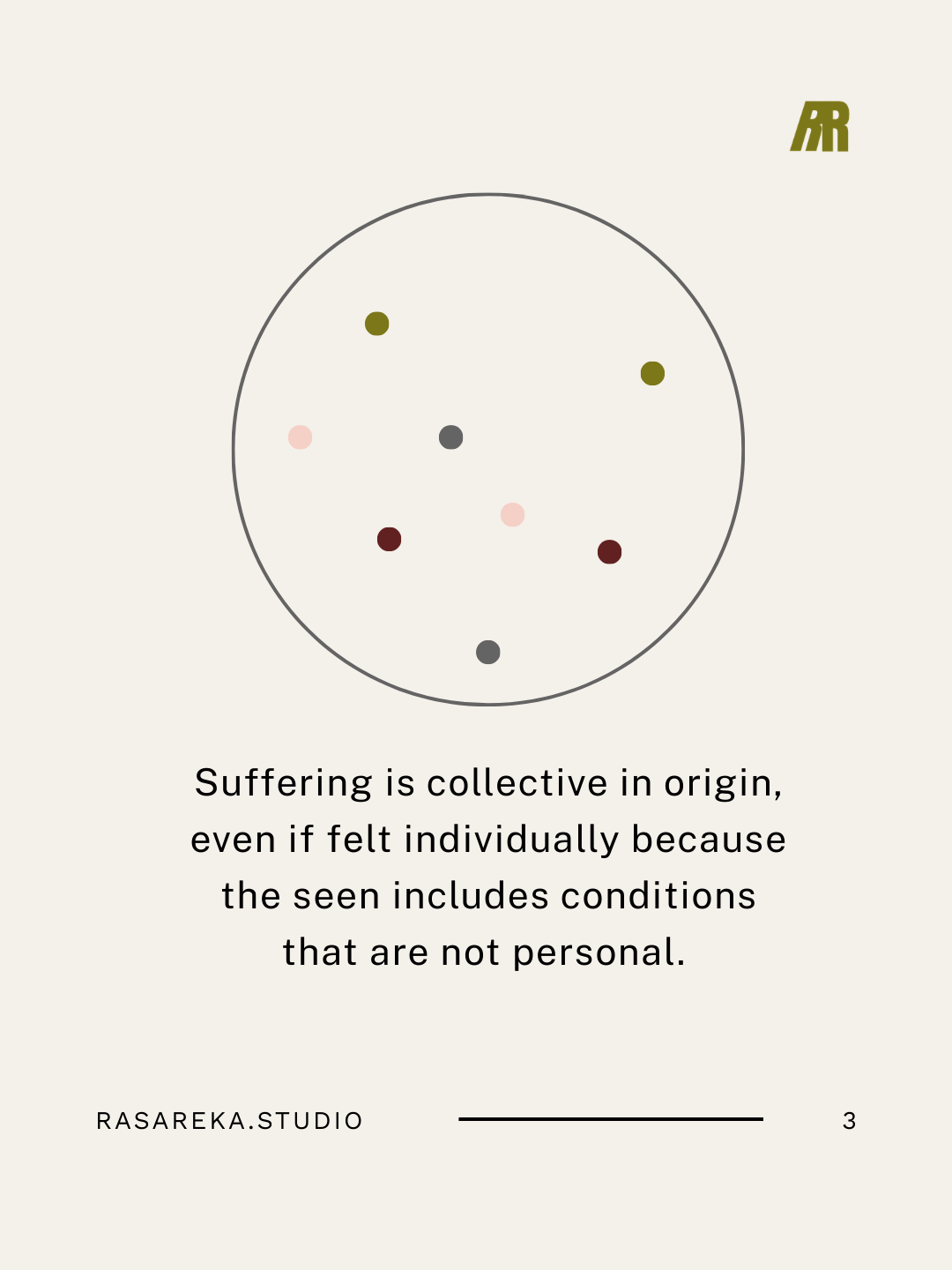
Importantly, prakṛti is not limited to what happens “inside” an individual. In Sāṅkhya philosophy, it is the shared field from which all experience arises.
This means social, historical, and material conditions are not outside the scope of yoga philosophy. They are part of what consciousness is moving through.
Samādhi and the Limits of Calm
Patañjali further clarifies this distinction through his discussion of samādhi.
In Yoga Sūtra 1.17, he describes samprajñāta (sabīja) samādhi as meditative absorption with seeds:
vitarka–vicāra–ānanda–asmitā-rūpānugamāt samprajñātaḥ
— Yoga Sūtras 1.17
This form of samādhi includes:
conceptual thought (vitarka)
subtle reflection (vicāra)
bliss (ānanda)
a refined sense of self (asmitā)
These states can feel deeply regulating, expansive, or peaceful. However, Patañjali distinguishes them from asamprajñāta (nirbīja) samādhi which means “absorption without seeds “ where misidentification itself ceases (YS 1.18).
In other words, even blissful or calm states are still conditioned experiences.
As scholar Edwin Bryant notes in his commentary on the Yoga Sūtras, liberation in this system is not a permanent emotional state, but freedom from identifying with any state at all, including the most refined ones.
Coping in Wellness Culture Now.
When yoga is practiced primarily as a coping mechanism, a way to manage stress, increase productivity, or maintain emotional balance, it remains largely at the level of bhoga.
This becomes especially significant within neoliberal culture, where responsibility for wellbeing is increasingly placed on individuals while structural conditions remain unaddressed.
In this context:
stress is individualized
burnout is medicalized
nervous systems are treated as personal projects
Yoga, when removed from its philosophical grounding, can unintentionally reinforce this pattern not because practitioners lack care or awareness, but because the broader frame is missing.
Historically, this gives us language.
Like many things, yoga did not enter the modern West in a vacuum.
Its popularization occurred alongside:
British colonial rule in South Asia
Racialized immigration laws in the United States (e.g. the 1923 Supreme Court ruling declaring Indians ineligible for citizenship)
The extraction and commodification of Asian spiritual traditions
At the same time yoga was marketed as universal and transcendent, the people and cultures it came from were often excluded, racialized, or erased. These histories shape contemporary yoga spaces, even when they are well-intentioned.
Discernment, a Practice of Seeing
Discernment (viveka) in yoga philosophy is not about rejecting the world. It is about seeing clearly what is conditioned and recognizing when relief becomes adaptation rather than understanding.
This matters because the conditions shaping bodies are not neutral.
Language. Labor. Land. Race. Caste. Citizenship.
These are lived structures that shape who has access to safety, rest, and recognition and who does not.
If yoga helps people cope without helping them see, it risks training adaptation without clarity.
And this is where yoga offers another possibility. An opportunity for discernment, not transcendence. An opportunity to see and not bypass.
So perhaps the question isn’t whether yoga helps.
Perhaps the question is what kind of seeing our practices are cultivating.
Not to arrive at certainty.
Not to bypass difficulty.
But to notice, with more clarity, the conditions we are living inside of and how we are being shaped by them.
Suggested Sources / Further Reading
Yoga Sūtras (esp. 1.17–1.18, 2.18, 2.26)
Sāṅkhya Kārikā
Edwin Bryant , The Yoga Sutras of Patanjali,
The Rise and Fall of Neoliberalism, The New Yorker.
