
How to Create a Sliding Scale that Works Better for You and Your People.
A few years ago, I offered sliding scale pricing for my custom website work. I believed (and still believe) in accessibility. I wanted the people I worked with to be able to afford what I was making for them. So I named a range, told people to pay what they could, and tried not to feel weird about it.
It didn't work. And, not because I did something wrong, but because I hadn't thought carefully enough about whether the sliding scale was the right tool for that kind of work.
Which is why in this blog I cover:
Why the sliding scale doesn't work for every type of offering
The frustrating pattern that shows up when it's not set up well
Who the sliding scale actually serves (and who it doesn't)
How to structure it so it works
Other access tools to reach for when the sliding scale isn't the right fit
For me, custom web design doesn't have a natural ceiling on time. There's no averaging-out the way there is when you teach a workshop to twenty people and a mix of them pay different amounts. Every project was its own universe of labor, and I was consistently undercharging while overdelivering. I also did a number of sites completely pro-bono and I'll be honest: most of them were never published. All that work just faded into the background which was dissapointing TBH.
I don't tell that story to discourage the sliding scale. I tell it because I think a lot of facilitators, healers, and teachers are in a version of it. Offering a sliding scale because they believe in access, but doing it in a way that slowly drains them, or that doesn't actually work the way they hoped.
So let's talk about what makes the sliding scale function well, what gets in its way, and what to do instead when it's not the right fit.

The problem nobody wants to say out loud.
Here's the frustrating thing about the sliding scale, and I say this with real compassion for everyone involved: in the US, we have very little education around money, class, service value, or fair wages. Most people don't have a clear picture of their own class position. Not where they are now, not how that might differ from where they grew up, and certainly not what privilege they carry relative to others.
The result is a pattern that most people who have used the sliding scale for any length of time will recognize: the people with the most financial flexibility often choose the lowest tier. And the people with the least money will sometimes pay a higher percentage of their income than their more comfortable peers. It's not (usually) cynical, it comes from a deep cultural confusion about what things are worth, what we're allowed to have, and what class we actually belong to versus the class we grew up in or imagine ourselves to be.
That inversion is maddening. You design the scale to flow resources toward those who need them most, and often the opposite happens. If you've felt frustrated by this, that frustration is valid. It doesn't mean you're doing something wrong. It means you're working with a tool that requires more than good intentions to function well.
What actually makes a sliding scale actually work
The sliding scale works best when it has structure (what some people call a managed sliding scale). Instead of a wide-open range where anyone picks any number, you offer a small number of defined tiers, with a limited quantity available at the lower end.
In practice, it might look something like this for a workshop:
3 spots at $40 - for those for whom paying more would create genuine hardship
5 spots at $60 - for those who can meet their needs but have little expendable income
Unlimited spots at $80 - the actual cost of the workshop
A pay-it-forward option at $90-$95 — for those who want to support access for others
A few things happen when you structure it this way. First, you protect your ability to get paid fairly. The math works because you're not leaving it entirely open. Second, it becomes transparent in a way that prompts people to make more honest choices. When someone can see that there are only three discounted spots and they're asking themselves whether they really need one, that's a different decision than clicking a number in a vacuum. Third, it gives people who want to contribute to access an easy, feel-good way to do so. That pay-it-forward tier is underused and under-appreciated and people genuinely like the chance to do a small good thing while buying something for themselves.
The other essential piece is clarity about what the tiers actually mean. Not just a range, but language that helps people self-select honestly. Something like:
The base price is the actual cost of this offering. If you choose a lower tier, you're receiving a discount.
The middle tier is for people who can meet their basic needs but have little or no expendable income. This would be a sacrifice, but not a hardship.
The lowest tier is for people for whom paying more would create real financial difficulty, not just inconvenience.
This kind of language does something important: it distinguishes between sacrifice and hardship. Most people, when they read it honestly, can feel the difference. And most people don't want to claim hardship they don't actually have.
Who the sliding scale actually serves?
Before getting into the mechanics, it's worth being honest about something the sliding scale conversation often skips: this tool works within a band.
It's designed for people who have some discretionary income, but for whom the difference between $80 and $40 is genuinely meaningful. That's a real group of people and they deserve access tools built for them. But the sliding scale is not a poverty solution. Let’s be real, someone without discretionary income (choosing between your workshop and a bill), isn't going to be reached by a lower tier. The weight of any cost is still too heavy.
For bigger-ticket offerings like teacher trainings or multi-day workshops, this gets more nuanced. People considering that kind of investment usually do have some discretionary income, otherwise the conversation wouldn't even start. But where that money comes from, and how much runway they have, varies enormously. Someone might have $500 saved and be choosing between your training and three months of financial breathing room. Someone else has the same $500 sitting in a checking account that refills every month. The price is identical. The weight of it is completely different.
So it's worth asking: does a sliding scale actually capture that difference well enough to justify the complexity? For some offerings, yes. For others (particularly high-investment ones), a scholarship fund might be more honest and more effective. A small number of people getting real, significant support is sometimes more meaningful than everyone getting a modest discount. Both approaches have a place. The question is which one fits the offering and the community you're actually trying to reach.
What I'd push back on is framing the sliding scale as "accessible to everyone." It's more accurate, and more trustworthy, to say it makes your work accessible across a range of financial situations within your community. That's a more modest claim, but it's a true one.
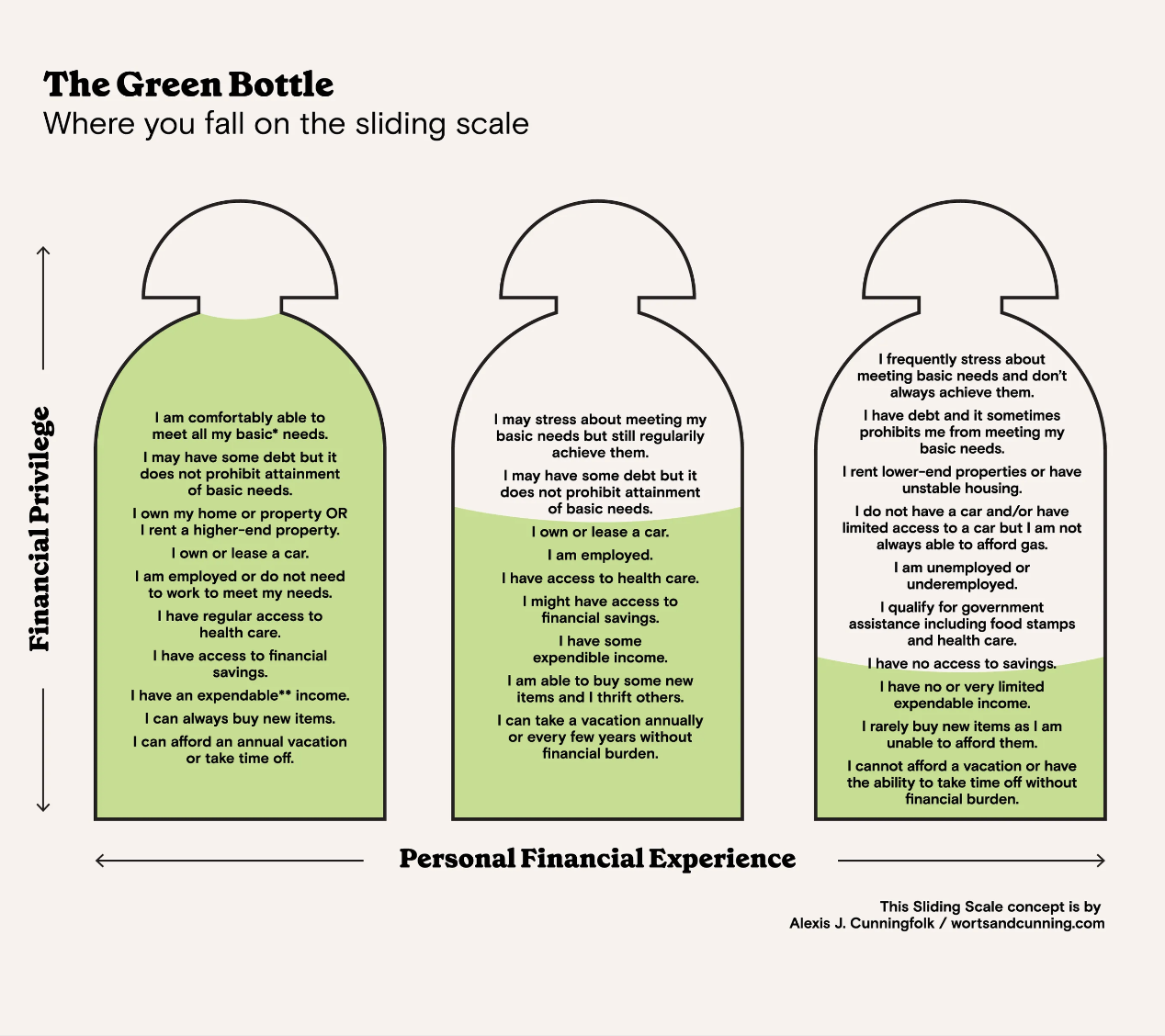
When the sliding scale isn't the right tool, there are other tools you can use.
For memberships, workshops, classes, and training programs (especially those with multiple participants) the sliding scale can work beautifully when set up well. The economics make sense: a range of people paying different amounts can average out to something fair, and the limited spots at each tier give you some control over that average.
Where it tends to break down is in one-on-one or highly customized work. Custom projects, especially ones that don't have a natural cap on time and energy. There's no group to average across. Every discount comes directly out of your own pocket, and if something goes sideways like a client goes quiet, a project drags, deliverables shift, you absorb that alone.
For that kind of work, other access tools tend to serve everyone better:
Payment plans. If someone needs a sliding scale for a big project, what they often actually need is more time to pay. A clear, standardized payment plan (same for everyone, automated where possible) removes the negotiation and the energy drain, while still making the work genuinely accessible. You don't have to customize it for each person; a consistent structure actually makes it feel more trustworthy, not less.
Discounts based on context. For non-profits, community organizations, or clients in specific circumstances, a straightforward discount can be more honest and easier to manage than a scale. You make the call, you name the number, and everyone is clear on why.
Scholarship or sponsored spots. For higher-investment offerings, consider setting aside one or two fully or significantly funded spots rather than discounting broadly. It's more labor to administer, but it creates real access for people the sliding scale won't reach and it's honest about what it is.
Pro-bono with real agreements. I've offered pro-bono work, and I've learned the hard way that doing it without clear agreements such as timelines, decision-makers, what "done" looks like, is a recipe for work that doesn't get used. If you want to give your work away, protect it with structure. A pro-bono agreement that's as clear as a paid one serves everyone better, including the recipient.
A note on mine (and maybe yours?) money story
Most people who are drawn to offering sliding scale pricing have something underneath the impulse worth looking at. Sometimes it's genuine values, a real commitment to access and equity. Sometimes it's also fear: fear of charging too much, fear of turning someone away, fear of seeming greedy or inaccessible. Those two things can coexist, and it's worth knowing which one is driving on any given day.
What I've noticed in my own work is that when I'm getting paid fairly, I can give more freely else where. Sometimes it’s in writing, in resources, in the relationships I build with my community.
If you've been offering a sliding scale and it's been working, that’s wonderful. If it's been quietly draining you, or if you've been avoiding it because you couldn't figure out how to explain it without a twelve-paragraph disclaimer, I hope this gives you something to work with.
Access is a value worth organizing your work around. The question is just which tools help you do that without burning yourself down in the process.
